
Tempered for Greatness: Pattern Folding and the Eastern Aesthetics of Traditional Chinese Swords
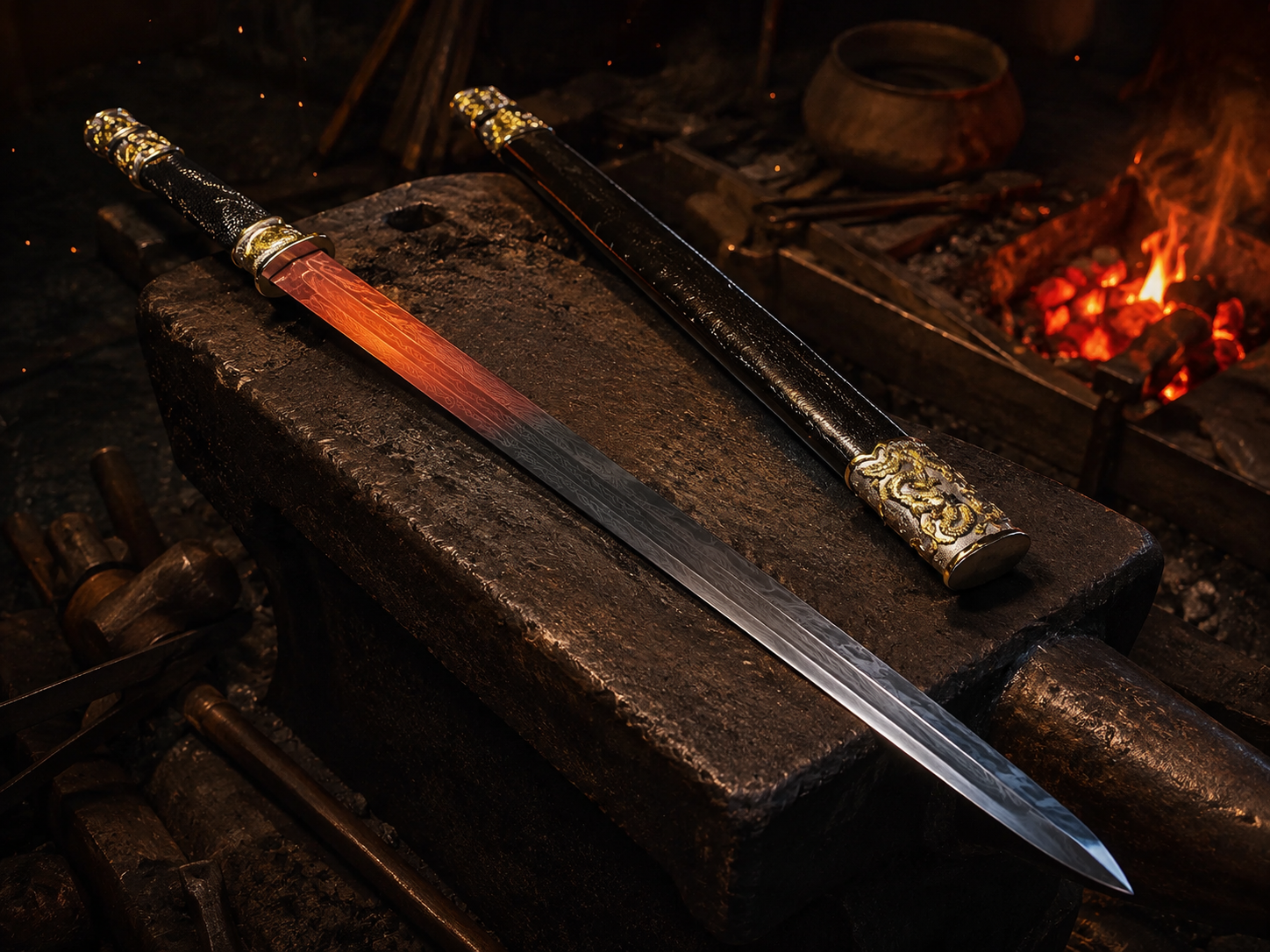
In the era of cold weapons, a fine Chinese sword was far more than a deadly battlefield weapon; it was a masterwork of craftsmanship and cultural philosophy. From the dignified simplicity of the Han Sword (Han Jian) to the formidable presence of the Tang Sabre (Tang Dao), behind every iconic blade lies the ancient technique of pattern folding and forging (the “Hundred-Refined Steel” process).
What is “Hundred-Refined Steel”? To remove impurities and evenly distribute carbon in iron, ancient blacksmiths repeatedly folded, heated, and hammered high-carbon and low-carbon steel together.
- Folding and Hammering: Every repetition compacts the internal crystalline structure of the steel.
- Combining Rigidity and Flexibility: By combining a high-hardness outer steel with a highly ductile core steel (such as in the Bao-Gang or Jia-Gang structures), the blade remains razor-sharp without snapping under heavy impacts.
Forged Aesthetics: Patterns Like Flowing Water Pattern folding yields not only superior performance, but also unique, stunning grain patterns known as pattern-welded steel (damascus/forged grain):
- Flowing Water Pattern: Features smooth, cascading lines mimicking natural streams.
- Feather Pattern: Highly complex and tightly aligned, resembling delicate spreading feathers.
- Pine Bark Pattern: A weathered, rugged texture often seen on heavy blades and sabres.
The Philosophy of Chinese Blades Design in Chinese swordmaking leans heavily into balance and uprightness. The Han Sword, with its straight, four- or eight-sided geometry, symbolizes nobility and moral integrity. The Tang Sabre, on the other hand, embodies the grand power of the Tang Empire, profoundly influencing East Asian swordmaking and standing as a golden age for Chinese weaponry.