
From the Han Sword to the Tang Sabre: The Evolution of Iconic Chinese Blades
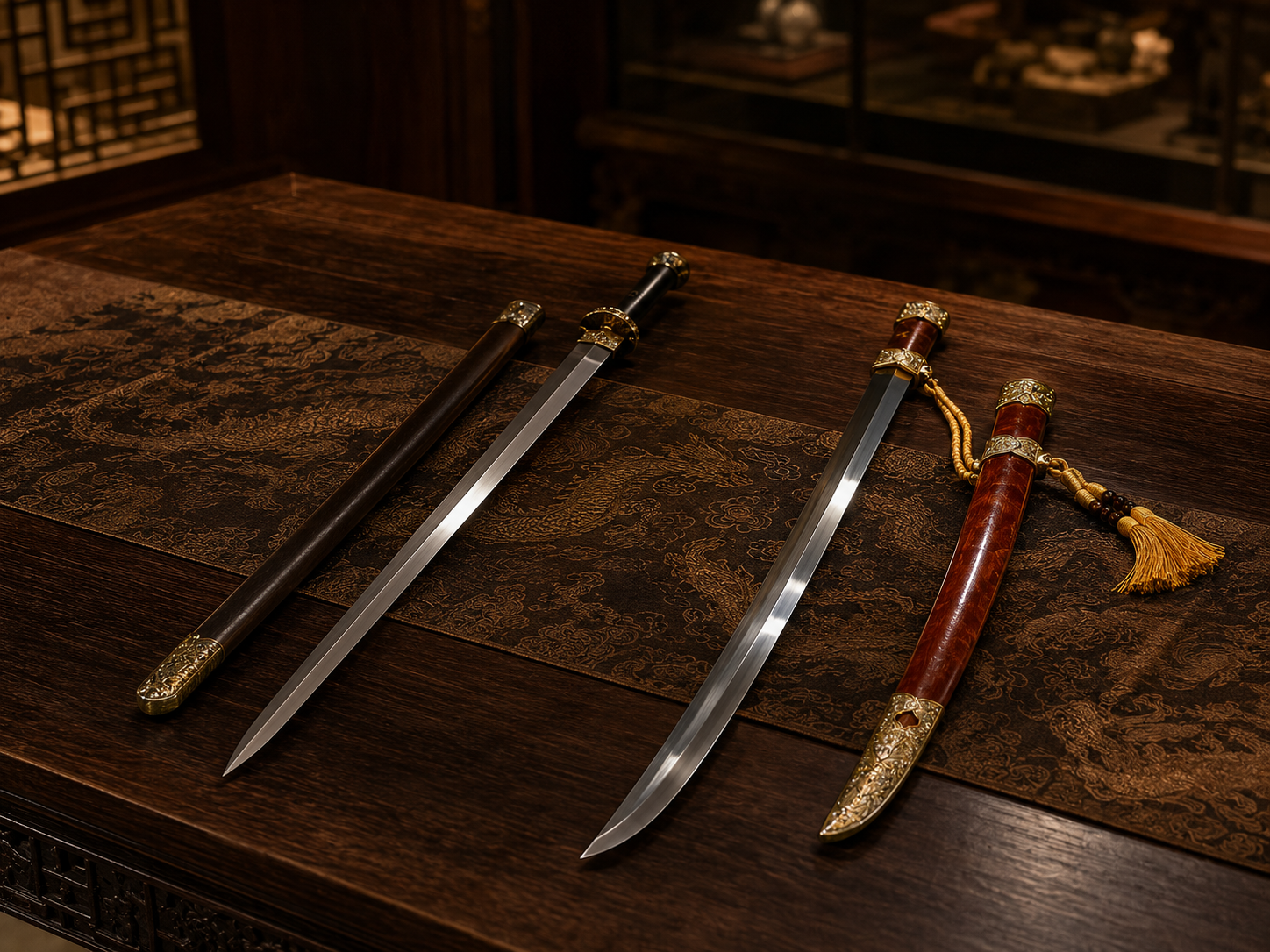
The evolution of ancient Chinese weapons was always tied to changing battlefield tactics and breakthroughs in metallurgy. Among all blade forms, the Han Sword and Tang Sabre mark two pivotal milestones.
The Han Sword: Peak of the “King of Weapons” The Han Dynasty marked the transition where iron completely replaced bronze in Chinese weaponry.
- Structural Features: Han Swords were straight and long, featuring four-sided, six-sided, or eight-sided blade geometry.
- Battlefield Role: Designed heavily for thrusting, long Han Swords combined with shields (Jian-Dun tactic) formed a dominant battlefield presence.
- Cultural Symbol: Beyond warfare, wearing a Han Sword signified high social status and scholar-warrior dignity.
The Tang Sabre: Battlefield Dominance Against Armor As cavalry expanded and heavy armor became widespread, powerful slashing sabres began replacing double-edged swords. The Tang Dynasty took sabre manufacturing to its absolute zenith.
- The Four Tang Sabres: Historical records (Tang Liu Dian) outline four categories: Yi Dao (ceremonial), Zhang Dao (defensive), Heng Dao (standard combat), and Mo Dao (heavy anti-cavalry two-handed sabres).
- Technological Breakthroughs: Utilizing differential heat treatment and advanced cladding techniques, the Tang Sabre boasted an extremely hard edge backed by a flexible spine, giving its straight-backed single-edge design devastating armor-cleaving power.
From Thrusting to Slashing The shift from the Han Sword to the Tang Sabre reflects a transformation in warfare: moving from the elegant, thrust-centric dual-handed sword techniques to a pragmatic, slashing-heavy era dominated by armored cavalry.